Maintenance
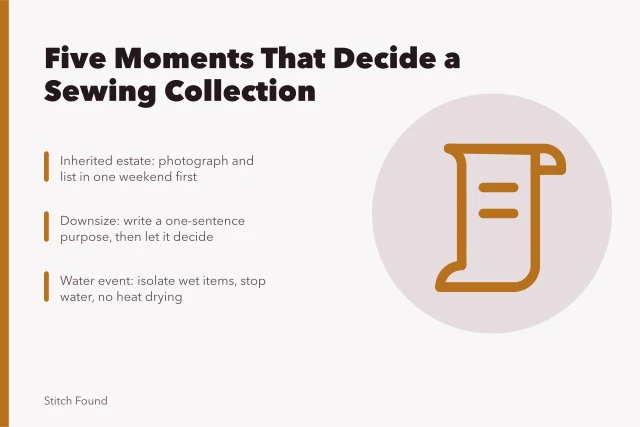
Part of What five recurring situations reveal about owning a sewing collection
Getting sewing collection case studies right the first time, updated for 2027
The collection mistakes that cost the most: separating objects from their records, assuming old means public domain, and leaving no plan for what happens next.
What to take away
- Separating an object from its paperwork is the most common irreversible loss.
- Old does not mean out of copyright. The term depends on facts you have to check, and 2027 moves the line again.
- A collection nobody else can understand becomes a house clearance.
- Households contain people of different ages, and the collection lives in the household.
- The sewing collection case studies below show where each mistake leads.
The ten mistakes, ranked by what they cost
Ten collection mistakes ranked
- Objects stored apart from records
- Never assigning accession numbers
- Cleaning before documenting
- Job lots never processed
- Assuming old means free
- No photographs for insurance claims
- Spreadsheet definitions drift
- Cheap plastics and adhesives
Sewing collection case studies, updated for 2027
Every mistake above has a public example. These six collections can be searched, visited or cited.
A case study here is a documented collection with a public record you can check. These six count because each one publishes an object-level record or a public account of what happened to its holdings. They are precedents, not anecdotes.
Sewing collection case studies
| Collection | What it holds | The lesson |
|---|---|---|
| Smithsonian National Museum of American History, Washington, DC | The Warshaw Collection of Business Americana, with sewing machine trade cards and catalogs. Free admission, typically open daily 10 a.m. to 5:30 p.m. | Trade literature is a collection of its own. Catalog leaflets as carefully as machines. |
| V&A Museum, London | Textiles and Fashion collections, including samplers and dress. Collections Online is searchable by object number. General admission is free. | A number on the object and on its record is what makes it citable. |
| McCord Stewart Museum, Montreal | Dress, Fashion and Textiles, with a free online database of digitized objects and photographs. | Digitized records are what let a stranger find the piece. |
| The Quilters Hall of Fame, Marion, Indiana | Housed in the Marie Webster House, a National Historic Landmark. Run by a small volunteer staff. | A small collection survives on a written purpose. |
| American Textile History Museum, Lowell, Massachusetts | Closed in 2016, and its textile holdings were dispersed to other institutions. | With no successor plan, the collection leaves your control. |
| National Quilt Museum, Paducah, Kentucky | Opened in the early 1990s and collects contemporary quilts. Admission is ticketed. | A narrow focus keeps a small museum coherent and fundable. |
The V&A and the McCord Stewart Museum publish object-level records with numbers, so a stranger can cite one item out of thousands. In your own home, copy that habit: give every object a number, and file the receipt and photograph with the object.
Why the paperwork separation is first
An object with its receipt, its photograph, its manual and a note of who owned it is a documented object. The same object with its papers in a different room is an anonymous item that somebody will eventually price as generic. Files get tidied, boxes get moved, and the connection breaks through ordinary housekeeping rather than disaster.
Fix it by storing the record with the object where possible, and by putting the accession number on both when it is not.
The accession-number fix starts here: number everything in one afternoon, oldest first, and write that number on the object and on its record.
Old is not the same as free
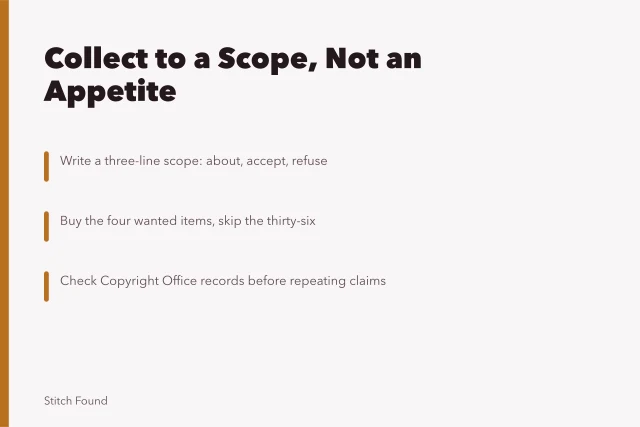
Collectors regularly assume that a leaflet, catalog page or advertisement from decades ago can be reproduced freely. Sometimes it can. Often the answer depends on when the work was created, whether it was published, and who created it.
The Copyright Office page on how long copyright protection lasts explains the rules, including the renewal requirement and what changes on January 1, 2027.
The practical rule for a collector is to check rather than assume, and to link to a source rather than republish it.
Leaving no explanation
A collection that only makes sense to its owner is a problem waiting for the owner's family. The American Textile History Museum closed in 2016, and its holdings went to other institutions. That is the good version of that story.
The summary page carries what the collection is, where the inventory lives, roughly what it is worth with the date of that figure, who might want it, and who to call. One page, kept with the records, takes about an hour.
The household is part of the storage plan
Collections do not live in vaults. They live in homes containing children, visitors, older relatives and pets, and the same objects that are precious to you are hazards to somebody else.
The Consumer Product Safety Commission organizes much of its guidance by safety content for different age groups, covering infants, toddlers, older children, caregivers and older adults. It is a useful prompt for thinking about who else uses the room your needles and blades are stored in.
Store needles, pins and blades in closed tins or cases, and keep them above the reach of a crawling child or a pet that climbs. Put the lid back on a tin before you leave the room.
Older adults with reduced grip or eyesight can cut themselves on a loose blade, so return each blade to its case after use.
Keep machine oil, lubricants and cleaning fluids in their original labeled containers. Store them away from kitchen and bathroom cabinets, and never in a drinks bottle. If a needle, pin or chemical is swallowed, call your local poison center at once.
Correcting what is already wrong
| Mistake | First correction |
|---|---|
| Records separated | Reunite by object, not by document type |
| Unprocessed job lots | Process or dispose, do not shelve again |
| No named successor | Name a dealer or a society on the summary page |
| Cheap enclosures | Replace on the highest-value items first |
| No summary page | Write it today. It takes an hour |
The material choices behind the fourth row are covered in our collection materials guide, and the situations that punish each of these mistakes are described in the collection case studies pillar.