Industry
Part of What five recurring situations reveal about owning a sewing collection
Beginner collectors can borrow scope, refusal and safety habits from dealers
Sewing collection case: what curators, dealers and long-time collectors do differently, collecting to a stated scope, saying no, and keeping a sharp-tool collection.
What to take away
- Experienced collectors say no far more often than they say yes.
- A written collecting scope is what makes saying no possible.
- Check public registers before repeating a claim a seller made about a document.
- A collection of sharp small objects in a family home needs an actual plan.
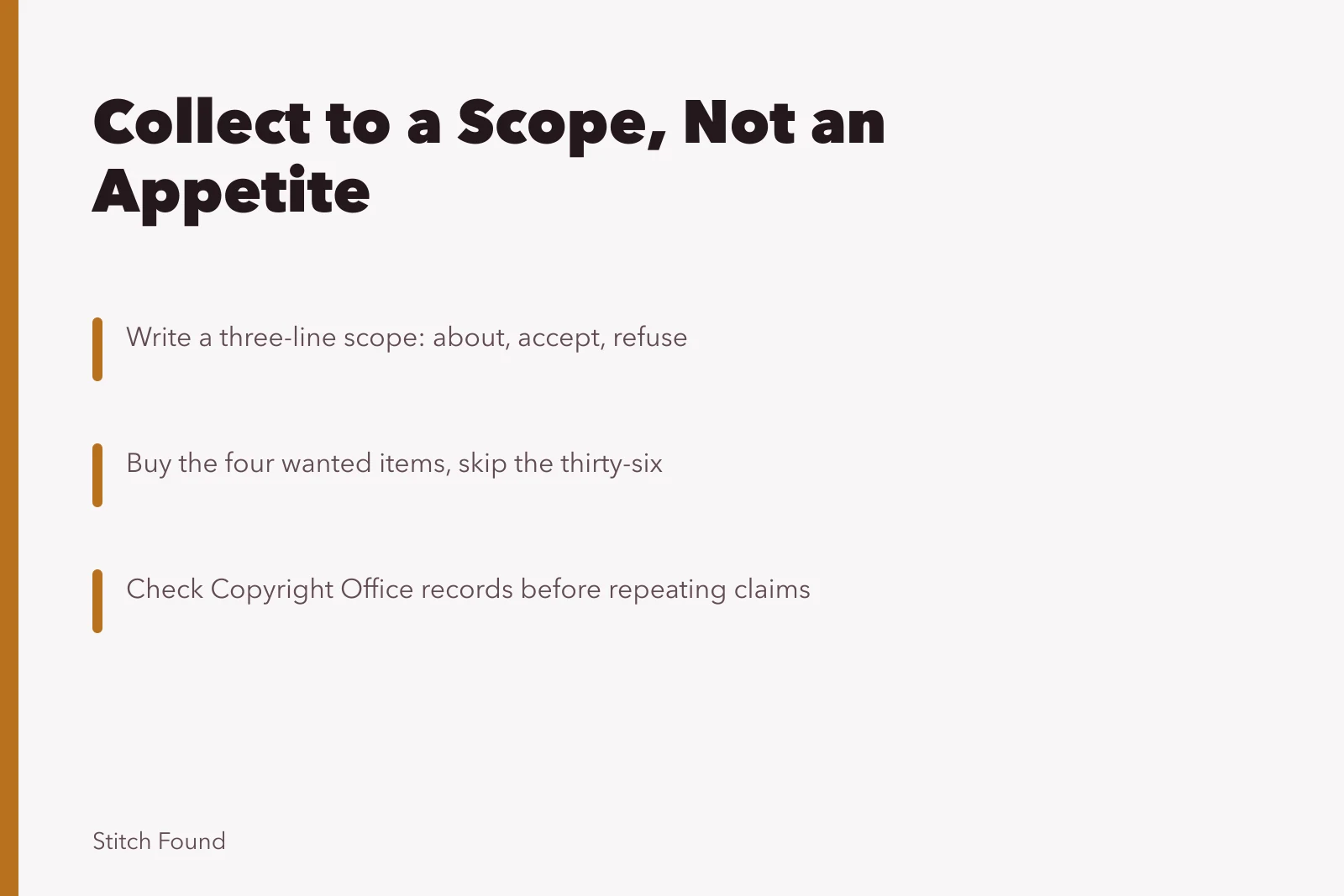
Collect to a scope, not to an appetite
Every curator works to a collecting policy: what the collection is for, what it will accept, and what it will not. Private collectors who stay solvent do the same thing informally.
Three-line collecting scope
- What the collection is about
- What it will accept
- What it will refuse even when cheap
A workable scope statement is three lines. What the collection is about. What it will accept. What it will refuse even when cheap. The third line is the one that does the work, because the objects that ruin a collection arrive cheaply and in bulk.
Saying no is a skill
The common failure is the job lot: forty items for the price of three, of which four are wanted. The other thirty-six then need housing, numbering, insuring and eventually disposing of, and the cheap lot turns out to have cost a shelf and a weekend.
Job lot: buy or refuse?
Does the lot contain only the items you want?
Buy the four, let someone else take the rest
Agree in advance what happens to the remainder and when
Buy the four. Let somebody else take the thirty-six.
Where a lot genuinely has to be taken whole, agree with yourself in advance what happens to the remainder and when. A date written down at purchase is the only thing that reliably stops a box of unwanted items becoming permanent furniture.
Verify before repeating a claim
Sellers pass on what they were told, and collectors repeat it. Where a claim concerns a publication, a catalog or an illustration, there is often a public record to check. The Copyright Office maintains public copyright records that can be searched directly, which is the appropriate first step before repeating an assertion about who published what and when.
Verifying a claim takes ten minutes. Repeating an unverified one attaches your name to it permanently.
Safety in a household collection
Sewing collections are unusual among collectibles in being made mostly of small, sharp, swallowable things. Needles, pins, blades, points and detachable parts all live in the same drawers as thimbles and reels.
Standard household guidance applies directly. The Consumer Product Safety Commission's toy safety guidance advises keeping small balls and items with small parts away from children under three, and notes that toys carry age labeling where they present a choking hazard. Antique sewing tools carry no such labeling at all, which makes the storage decision entirely yours.
The practical answer is a locked or high cabinet for anything sharp or small, and a supervised handling routine rather than open access. Pins and needles that escape a cushion are the everyday version of the problem, so a magnetic sweep of the floor after a working session is worth more than any lock.
Habits worth copying from working collectors
Habits worth copying
| Habit | Why it matters |
|---|---|
| Written scope | Makes refusal easy and consistent |
| Number on arrival | Nothing enters undocumented |
| One in, one out | Keeps the collection at a size you can care for |
| Buy the best example, not the cheapest | Fewer, better objects age well |
| Record what a seller claimed | Separates evidence from sales talk |
The pricing discipline behind the fourth line is covered in our article on how dealers value machines, and the situations that test all five appear in the collection case studies pillar.