Features
Part of What five recurring situations reveal about owning a sewing collection
Six single-skill drills that sharpen sewing collection management habits
Six single-skill drills for collection work: accession numbering, condition reports, reading a copyright notice, provenance checks and a packing test.
What to take away
- One skill per project. Combining them means learning none of them properly.
- An accession number is the single highest-value habit in collection work.
- Condition reports are written to be read by a stranger, including future you.
- Provenance checking is mostly free and mostly disappointing, which is the lesson.
Project one: build an accession system
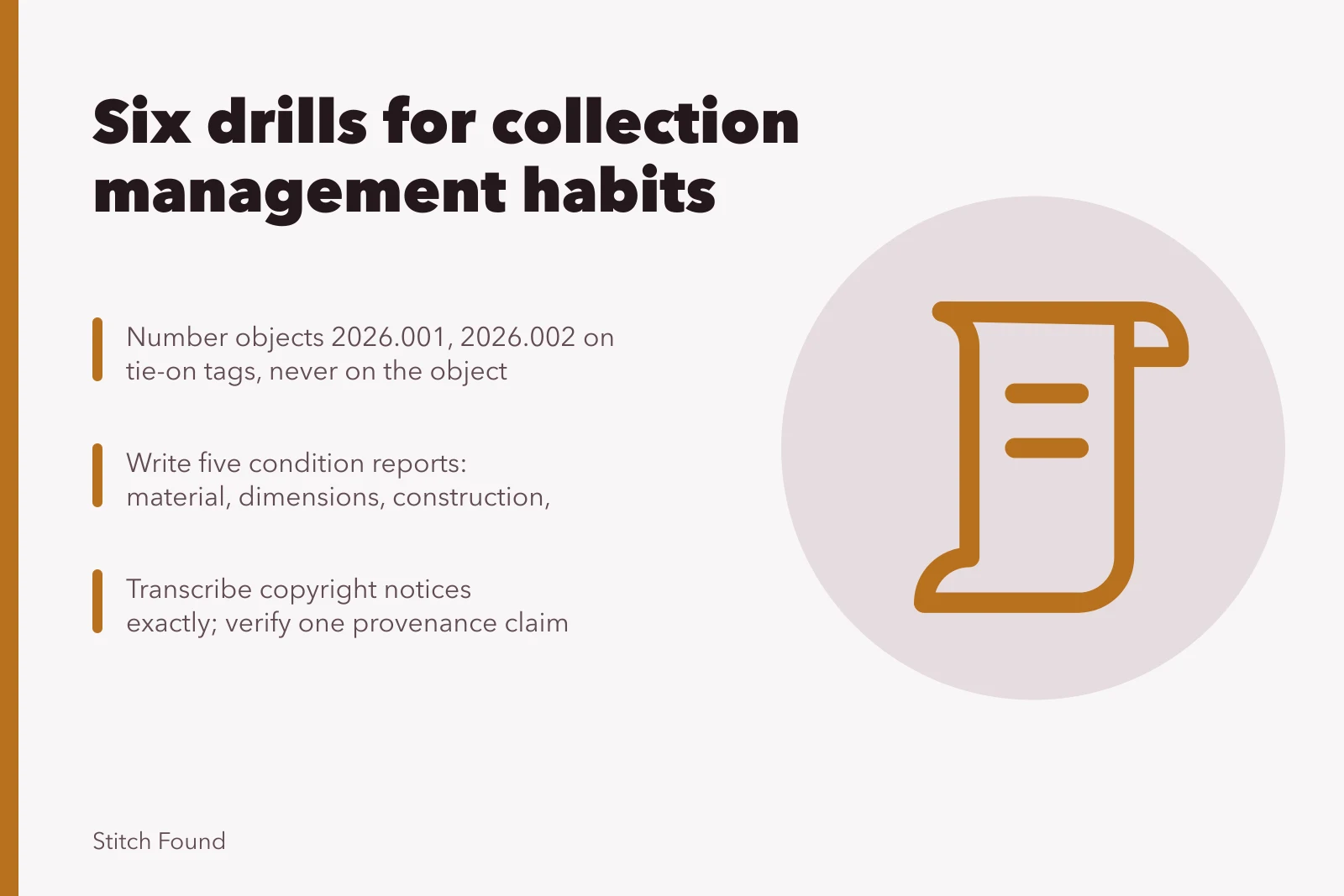
Give every object a permanent unique number in one afternoon. A simple year and sequence format works: 2026.001, 2026.002. Write the number on a tie-on tag, never on the object, and record it in one list with a one-line description.
Accession numbering in one afternoon
- Assign permanent unique number
- Use year and sequence format
- Write number on tie-on tag
- Never write on the object
- Record in one list
- Add one-line description
Twenty objects takes an hour. Everything else in collection work depends on this existing.
Do not go back and improve the format later. A numbering scheme that changes halfway through is worse than a crude one applied consistently, because every old reference now points somewhere ambiguous.
Project two: write five condition reports
Pick five objects and write a paragraph each: material, dimensions, construction, damage, previous repair, and stability. Use plain descriptive language and avoid judgment words. "Two millimeter chip at the rim, stable" is a report. "Slightly damaged but fine" is not.
Condition report elements
- Material
- Dimensions
- Construction
- Damage
- Previous repair
- Stability
Read them a month later. The ones you cannot picture from the description need rewriting.
Photograph each object at the same time and file the image with the report. A report and a photograph together answer the only question a condition report is ever asked, which is whether anything has changed since it was written.
Project three: read a copyright notice
Take every piece of printed paper in the collection and look for a copyright notice, then transcribe what you find exactly. The Copyright Office's circular on copyright notice explains the elements of a notice, where it was required and where it was optional, and its legal effect.
This is a twenty-minute exercise that changes how you read every leaflet and manual afterwards, because you learn what the marks on the page were actually doing.
Project four: try to verify one provenance claim
Take one family story attached to one object and try to confirm any part of it using free records. Military service is a common thread in these stories, and the National Archives sets out how to approach military records research by branch, by conflict and by topic.
Expect to fail more often than not. The value is learning how much weight an unverified story can carry, which is very little, and how much a single confirmed date adds, which is a great deal.
Project five: the packing test
Pack one object as though it were being shipped, then unpack it and inspect. Did anything shift? Did tape touch a surface? Was the box the right size?
Check / Pass condition
- Movement in the box
- None when shaken gently
- Contact with adhesive
- No adhesive touches the object
- Support at weak points
- Handles and spouts supported
- Outer box crush test
- Firm pressure produces no contact
- Label survives
- Legible after handling
Project six: a one-page collection summary
Write a single page a stranger could read: what the collection contains, why it exists, where it is kept, and where the records are. This is the document your family will actually use.
The valuation drills that pair with these appear in our valuation projects article, and the situations that make all six of them worth doing are described in the collection case studies pillar.