
Reviews
Part of Build a sold-comparables record for vintage machine values
Vintage machine values materials: how to grade the finish
Vintage machine values materials: a four-grade scale for japanning, decals, plating and cabinet timber on a sewing machine, and why original finish ranks high.
Vintage machine values materials start at the finish: the japanning on the head and bed, the decals laid over it, and the plating on the bright parts. This article covers what each of those surfaces tells a buyer about originality, how to grade it, and how to read it without causing damage. It ranks materials by their effect on value; it does not give sale prices, which depend on the model, the local market and the comparables you build.
What to take away
- Original surface beats improved surface almost every time in the resale market.
- Decal condition is the single most visible value signal on a black enamelled head.
- Plating wear is progressive and irreversible. Polishing accelerates it.
- Identifying a finish is an analytical question, and guessing costs more than asking.
The materials that drive value
| Material | Where it appears | Value effect when original |
|---|---|---|
| Japanned black finish | Head, bed, arm | High, if unpolished and uncracked |
| Transfer decals | Arm, bed, pillar | Very high, and easily destroyed |
| Nickel plate | Faceplate, handwheel, fittings | Moderate, wears through at edges |
| Chrome plate | Later fittings | Moderate, pits rather than dulls |
| Cast iron | Frame, treadle stand | Low on its own, high when unbroken |
| Bentwood case | Portable machines | Moderate, veneer damage is common |
| Cabinet timber and veneer | Treadle and electric cabinets | Local value, poor shipping economics |
| Early plastics | Knobs, spool pins, later parts | Low, but shrinkage signals age |
Why original surface wins
Buyers who know the market pay for evidence, and a finish carries evidence. Wear patterns show how a machine was used. Decal loss at the front edge of the bed says somebody sewed on it for decades. A uniform glossy black head with crisp modern decals says something else entirely, and the market discounts it accordingly.
The rule holds even for tired examples. A worn original finish is a starting point for a future owner. A repaint is a decision already taken for them.
Finish identification is a laboratory question
People routinely guess whether a surface is japanning, later enamel, shellac or a modern rattle-can respray. They guess wrong. Institutions do not guess.
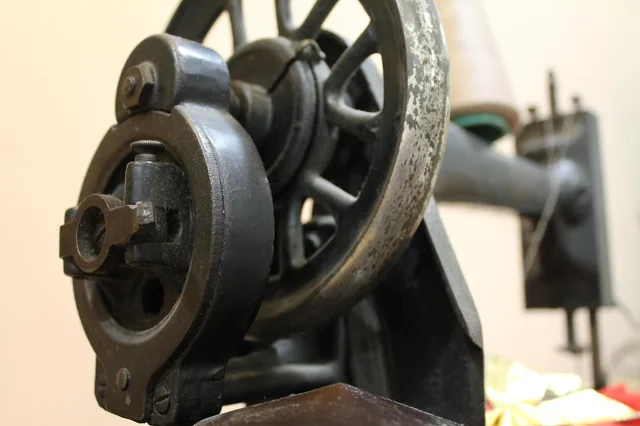
What you can do at the bench is read the clues. Japanning is a baked, asphaltum-based black finish: on an original head it sits deep and slightly soft-looking, with fine crazing in old examples and decals that lie under the clear coat, flush with the surface. A later sprayed enamel tends to look uniformly glossy, fills the casting texture and the decal edges, and often shows overspray where no factory would have sprayed. A rattle-can respray usually leaves runs at the bottom of the bed and paint on the screw slots.
Decals are where collectors put names to value. On Singer machines the decal sets have collector names, such as Red Eye on the Singer 66 and Sphinx on the Singer 27 and 127, alongside sets known as Gingerbread and Egyptian, and a buyer prices a machine by how much of that set survives on the bed and arm. Note which set is on the machine and how complete it is before you think about anything else. Collectors compare those sets through clubs such as the International Sewing Machine Collectors' Society (ISMACS).
The National Archives runs a heritage science laboratory whose equipment and capabilities include Fourier transform infrared spectroscopy, X-ray fluorescence, and gas chromatography with mass spectrometry. These tools analyze materials elementally and molecularly. You will not be sending a sewing machine head there. The useful takeaway is that a confident verbal identification of a coating carries roughly the authority of a coin toss, so record what you observe and describe it as apparent rather than certain.
Materials measurement is a whole discipline for the same reason. NIST's Materials Science and Engineering Division exists because material behavior is not obvious from inspection. Describe the surface you can see instead of giving a coating a name you cannot prove.
Practical tests you can run without harming anything
- Look at edges and high points under raking light. Plate wears there first.
- Check the inside of a faceplate. Overspray on unseen surfaces means a repaint.
- Look at screw heads. Paint bridging a slot was applied after assembly.
- Run a fingernail across a decal border. A raised edge means a modern transfer.
- Smell the cabinet. A fresh solvent smell on an old cabinet is recent work.
None of these is conclusive alone. Two or three together usually are.
Finish inspection checklist
- Edges and high points under raking light
- Inside faceplate for overspray
- Screw heads for paint bridging
- Decal border for raised edge
- Cabinet for fresh solvent smell
What this means for grading the finish
Grade the finish separately from the mechanics, and say so in the listing. A four-grade scale is enough, applied to each surface on its own line:
- Original, complete.Factory finish unbroken, no paint over it, the decal set present across bed and arm with only light rubbing, plating dull but not worn through.
- Original, worn.Factory finish with honest use: decal loss at the front edge of the bed and around the needle plate, plating worn through on edges and high points, fine crazing in the black.
- Original, heavily worn.Large parts of the decal set gone, chips or rust spots in the finish, plating lifting, but still nothing applied over the original surface.
- Refinished.Any repaint, re-plating or reproduction decals, at any quality. Say what was done and when, if known.
Write one grade per surface, for example "head finish 2, decals 3, plating 2, cabinet 4", rather than one grade for the machine. The surfaces carry value in the order of the table above: decals first, then japanning, then plating, then cabinet timber, with early plastics last. A mechanically perfect machine with a repaint and a mechanically tired machine with intact decals appeal to different buyers, so price them against different comparables.
The guide to planning around vintage machine values covers how those separate comparable sets get built. Working dealers in our advice from makers explain why shops discount refinished machines more than owners expect.