Reviews
Vintage machine models compared: a published test protocol beats any favorites list
Compare real vintage sewing machine models on stitch quality, parts supply and price, then test each one under published protocol conditions.
What to take away
- Vintage machine models compared herethe Singer 201, 15-91, 66, 99K and 221 cover most of what a home sewer needs.
- A rotary hook machine (201) forms stitches faster and quieter than an oscillating hook one (15-91).
- The 221 Featherweight costs more than a 99K that sews the same straight seam: typically $250 to $600 against $75 to $200.
- Parts supply decides long-term cost more than purchase price does.
- The seven-line protocol below lists needle, thread, fabric and settings for each job.
Seven vintage models compared by name
Prices below are typical US asking prices as of 2026 for a working machine with a case, not for a restored showpiece. They were last checked in September 2026.
Singer 201 (1935 to 1957). Rotary hook, gear-driven, full-size. It is the quietest straight-stitch machine Singer built, and the one to want for long seams on cotton and linen.
Singer 201-2 motor. The potted motor is the weak point. A rewound or replaced motor is a job for a licensed electrician working to NFPA 70, the National Electrical Code, not a bench task. Parts sellers such as Sewing Parts Online stock replacement motors, gears and bobbin cases, and parts are common.
Singer 15-91 (1932 to 1957). Oscillating hook, direct-drive gear motor, class 15 bobbin. It tolerates canvas and denim better than its smoothness suggests. Class 15 bobbins and 15x1 needles are sold everywhere, which keeps running cost low. Expect more noise than the 201.
Singer 66 (1902 to 1960s). Transverse shuttle, back-clamping feet, long bobbins that are no longer made in volume. It is simple and nearly indestructible. The bobbin supply is the reason to think twice.
Singer 99K (1930s to 1950s). The 66 mechanism in a 3/4-size aluminum body. Same long bobbin problem, lighter to carry, and often half the price of a Featherweight for identical stitch quality.
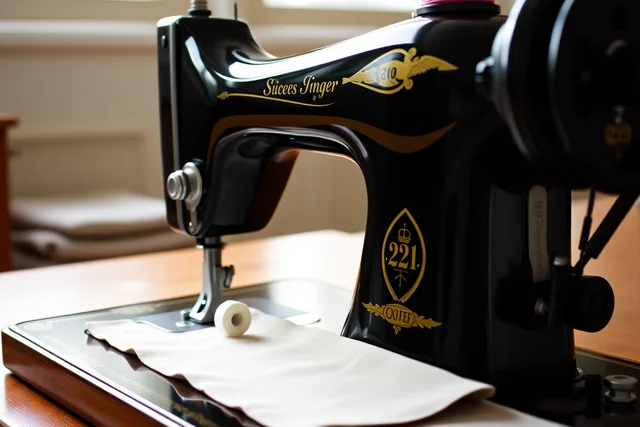
Singer 221 Featherweight (1933 to 1964). Rotary hook, belt-driven, 11 pounds. It travels well and holds value. The price premium buys portability and the case, not better stitching.
Bernina 530 Record. Swiss, oscillating hook, and a feed that handles fine fabric well. Parts cost more than Singer parts and come from Bernina dealers or used-parts sellers on eBay.
Pfaff 130. German, built-in zigzag, and parts are harder to find than Singer parts.
Add the Bernina 530 Record or the Pfaff 130 if the work needs zigzag.
What each one is actually for
| Model | Mechanism | Best for | Typical US price | Watch for |
|---|---|---|---|---|
| Singer 201 | Rotary hook | Long straight seams, quilting | $150 to $400, more with a cabinet | Potted motor failure |
| Singer 15-91 | Oscillating hook | Canvas, denim, general repair | $75 to $200 | Noisier, slower |
| Singer 66 | Transverse shuttle | Simple straight work | $50 to $150 | Long bobbins scarce |
| Singer 99K | Transverse shuttle | Small spaces, travel | $75 to $200 | Same bobbin issue |
| Singer 221 | Rotary hook | Portability, resale | $250 to $600 with case | Price premium |
| Bernina 530 | Oscillating hook | Fine garment work | $300 to $700 | Costlier parts |
| Pfaff 130 | Oscillating hook | Zigzag, stretch | $150 to $500 | Parts supply |
Heavy canvas and leatherwork want the 15-91 or a 66 with a fresh needle. Garment work wants zigzag, so the Pfaff 130 or a later machine. Teaching a child suits a hand crank because the speed is under their control.
The seven-line test protocol
Any claim about a model should come with the conditions under which it was made.
Published test protocol
- State needle system and size, needle new
- State thread type and weight, top and bobbin
- State fabric fiber, weight, weave, layers
- State stitch length, tension, presser foot
- Sew fixed sequencestraight, four layers, cross-seam, taper
- Photograph both sides, keep sample dated
- Note anything that stopped the test
Each row below fixes the needle, thread, fabric, stitch length and settings for one run.
| Fabric or job | Needle | Thread | Stitch length | Settings to hold |
|---|---|---|---|---|
| Cotton broadcloth | 11/75 universal | 50 wt cotton or all-purpose polyester | 2.5 mm | Mid tension, standard foot |
| Mid-weight linen | 14/90 sharp | 40 wt cotton or polyester | 2.5 to 3 mm | Mid tension, light pressure |
| Denim, 12 oz | 16/100 jeans | 40 wt polyester | 3.5 mm | Mid tension, firm pressure |
| Cotton canvas, 10 oz | 18/110 | 30 wt polyester or bonded nylon | 4 mm | Mid tension, firm pressure, slow speed |
| Silk or chiffon | 9/65 sharp | 60 wt fine | 1.8 to 2 mm | Mid tension, light pressure, tissue beneath |
| Jersey or rib knit | 11/75 ballpoint | 40 wt polyester, wooly nylon in the bobbin | 2.5 mm | Mid tension, light pressure, no stretching |
| Garment leather, 2 to 3 oz | 16/100 leather point | 40 wt bonded nylon | 3 mm | Mid tension, firm pressure, slow speed |
Needle and thread sizes here are the usual choices for each material.
The sequence matters as much as the list. Testing on whatever fabric is at hand, then switching fabric when a result disappoints, compares fabrics rather than machines. Fix the materials, vary only the machine, and accept what the result says.
Why the protocol beats a verdict
In regulated categories, claims rest on testing by accepted laboratories. The Consumer Product Safety Improvement Act, summarized by the Consumer Product Safety Commission on its CPSIA overview page, added third-party testing, certification and tracking labels.
None of that applies to two old machines on a kitchen table. The NIST SI redefinition page ties base units to fixed constants of nature, so a measurement means the same thing anywhere. A home test cannot meet that standard. It can state its references instead of hiding them.
Choosing without buying first
Try before you commit, and identify precisely what you are trying. Local repair shops, quilt shows and estate sales let you stitch on a machine before you pay. Marketplaces such as eBay, Craigslist and Facebook Marketplace list most of the rest.
Try before you commit
Can you stitch on the machine first?
Test it and identify the model
Identify the model before buying
The workflow in our machine identification guide is the prerequisite, because a test result attached to the wrong model name is worthless. Cost planning is covered in the price guide.
Common questions
Is a straight-stitch-only machine a limitation?
For garment sewing, yes. Heavy work and quilting need only straight stitch. The 201 and 15-91 are straight-stitch only and still sought after.
Does a heavier machine sew better?
Mass reduces walking at speed. It does not improve stitch formation on its own. A well-timed 99K beats a badly timed 201.
Should I trust online model rankings?
Only where the test conditions are published. Otherwise treat them as preferences.
How many machines does a home sewer need?
One that suits the work, plus a hand crank if you enjoy them. Two is plenty. The 221 is a travel machine, not a second workshop.