Costs
Part of Sewing repair business models worth watching under review: the good, the weak and the verdict
Does a five-line cost sheet set a fair sewing repair business price
Job costing for a sewing repair shop: materials per job, markup on parts, minimum charges, and why the cheapest fabric supplier is rarely the cheapest one.
What to take away
- Price the job, not the part. Materials are usually the smallest line on the invoice.
- A minimum charge is not greed. It covers intake, testing and paperwork.
- Buy fabric and trim from suppliers who can tell you what standards the goods meet.
- Waste and offcuts are a real cost. Count them or they eat the margin quietly.
Build the job cost from five lines
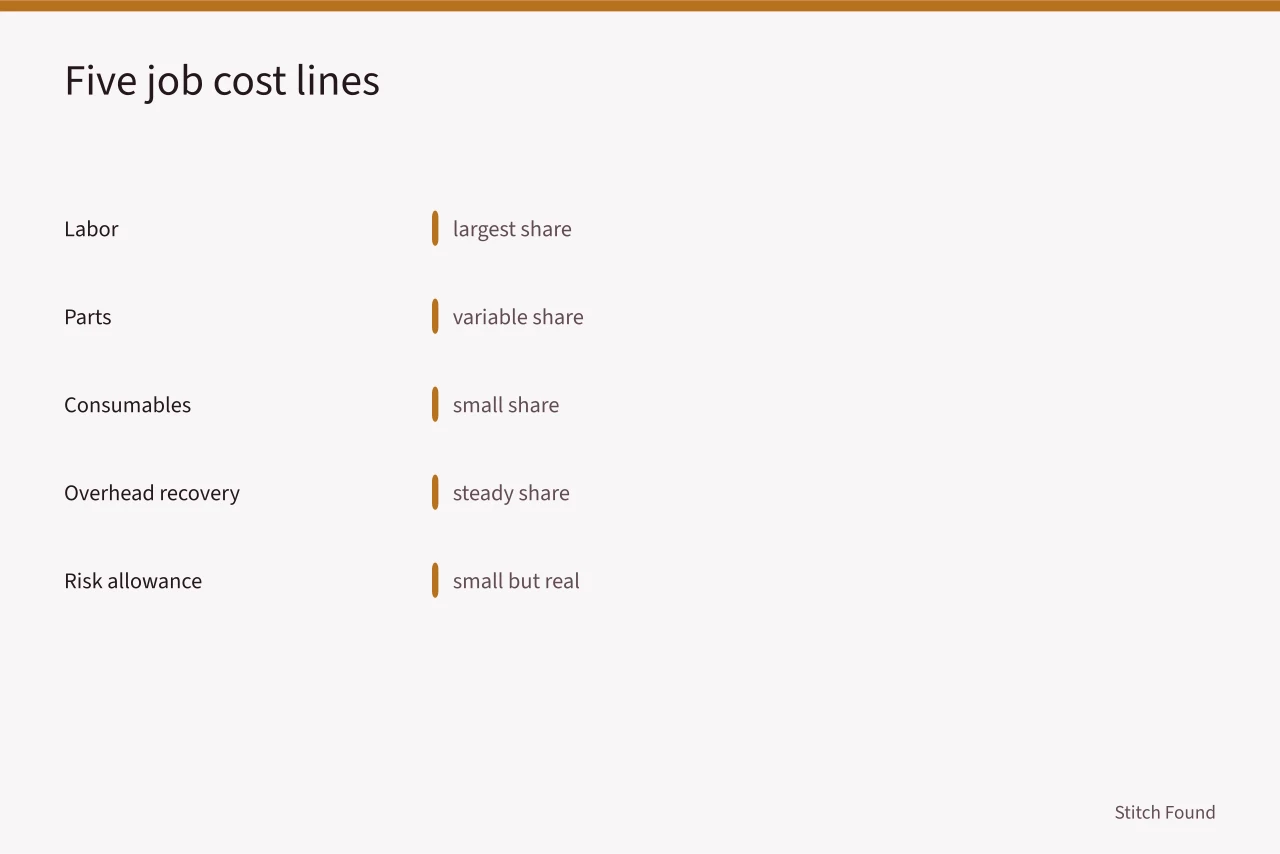
| Line | Typical share | Notes |
|---|---|---|
| Labor | Largest by far | Include intake, testing and write-up |
| Parts | Variable | Marked up to cover sourcing and risk |
| Consumables | Small | Needles, thread, oil, cloth, per job |
| Overhead recovery | Steady | Rent, power, insurance, software |
| Risk allowance | Small but real | Reworks, returns, the occasional write-off |
New shops routinely price only the first two lines and wonder where the money goes. Consumables and overheads do not send an invoice; they just reduce what is left.
Set a minimum charge and explain it
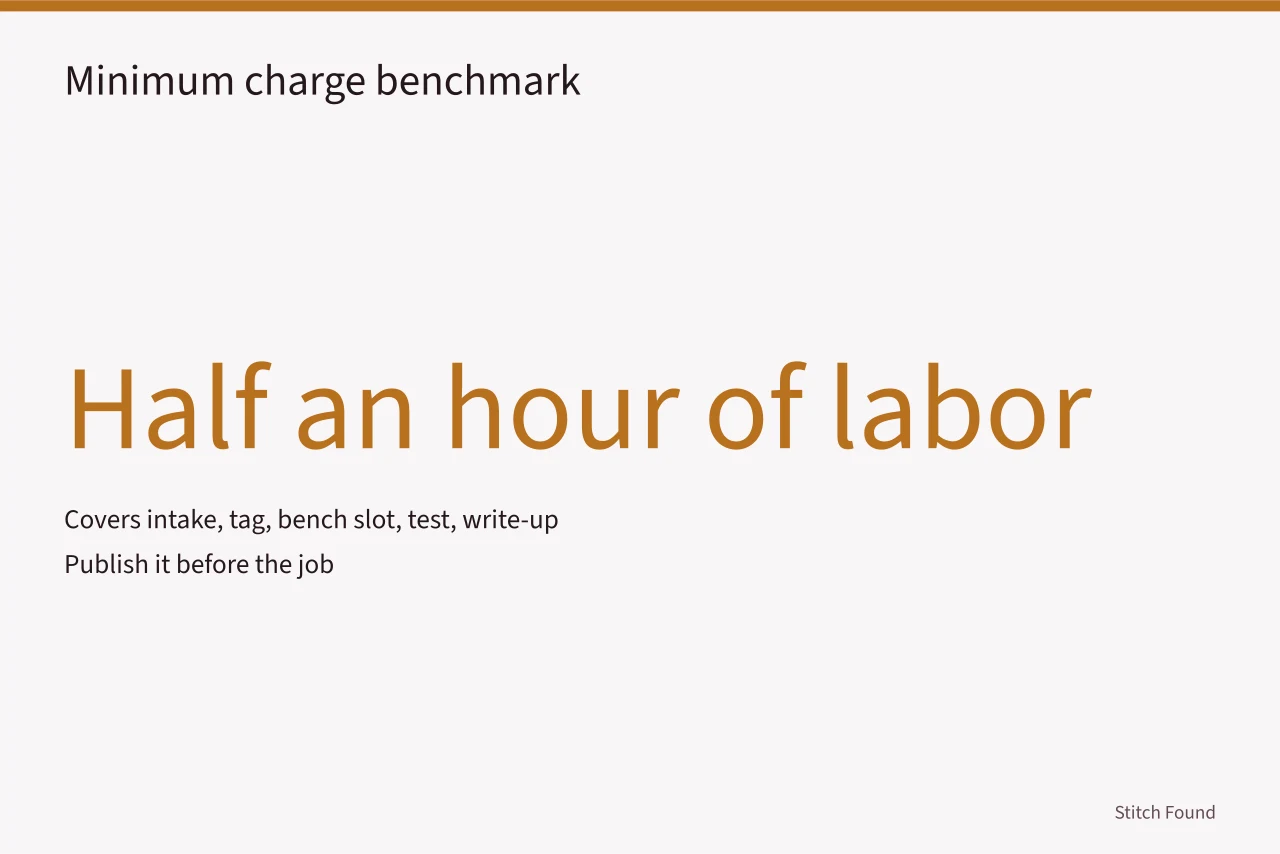
Every job, however small, consumes intake time, a tag, a bench slot, a test and a write-up. A minimum charge equal to roughly half an hour of labor is normal and defensible. Publish it. Customers accept a stated minimum far more readily than a surprise one.
Buying cloth: cheapest is not cheapest
Repair and alteration work consumes lining, interfacing, elastic, thread and occasionally fashion fabric. The cheap supplier who cannot tell you fiber content or standards compliance is a false economy, because you are the one whose name is on the finished garment.
Apparel fabrics sold in the United States fall under a federal flammability standard, the Standard for the Flammability of Clothing Textiles at 16 CFR part 1610, which sets out the test method and the classes into which textiles are placed.
Enforcement is not hypothetical. The Consumer Product Safety Commission's clothing and accessories recall listing carries notices such as children's sleepwear recalled for failing to meet the applicable flammability standard.
For a repair shop the working rule is to buy from suppliers who can answer questions in writing, and to be especially careful with anything going into children's garments.
Markup on parts, honestly
Parts markup covers sourcing time, carrying stock, returns of wrong parts, and the risk that a part fails. Somewhere between a third and double the cost price is typical depending on how hard the part was to find. What matters more than the percentage is that it is consistent and that you can explain it.
Do not mark up a part and also bill the hour you spent finding it. Choose one, say which one on the invoice, and apply it the same way to every customer.
Customer-supplied parts deserve their own policy. Fitting a part somebody bought online means you carry the risk that it is the wrong system without earning the margin that normally pays for that risk. Either decline them or charge for the fitting time regardless of outcome, and say so before the job starts.
Track waste for a month
Weigh or count offcuts, ruined thread, mis-cut interfacing and test fabric for four weeks. Most shops find waste running at a noticeable share of materials spend, and most find it concentrated in one or two jobs types that were priced as if waste were zero.
The equivalent exercise for a workshop rather than a business is in our restoration supplies costing guide, and the shape of business you are pricing for is covered in the repair business overview.
Common questions
Should I publish prices? Yes for standard services. Assessment-based quotes for anything else.
How often should prices be reviewed? Twice a year, and immediately after any supplier increase you absorbed.
Is it worth buying consumables in bulk? For needles, thread and oil, yes. For anything with a shelf life or a fashion element, no.
Do customers accept a minimum charge? Almost always, when it is displayed before they hand the item over.